Four programs for understanding urban ecological change.
The portfolio is organized around habitat structure, behavioral response, environmental sensing, and decision systems. Each program is defined by a question, a protocol path, and a release standard.
Urban garden habitat context in Atlanta.
PROGRAM ARCHITECTURE
Research questions are separated from claims of completed evidence.
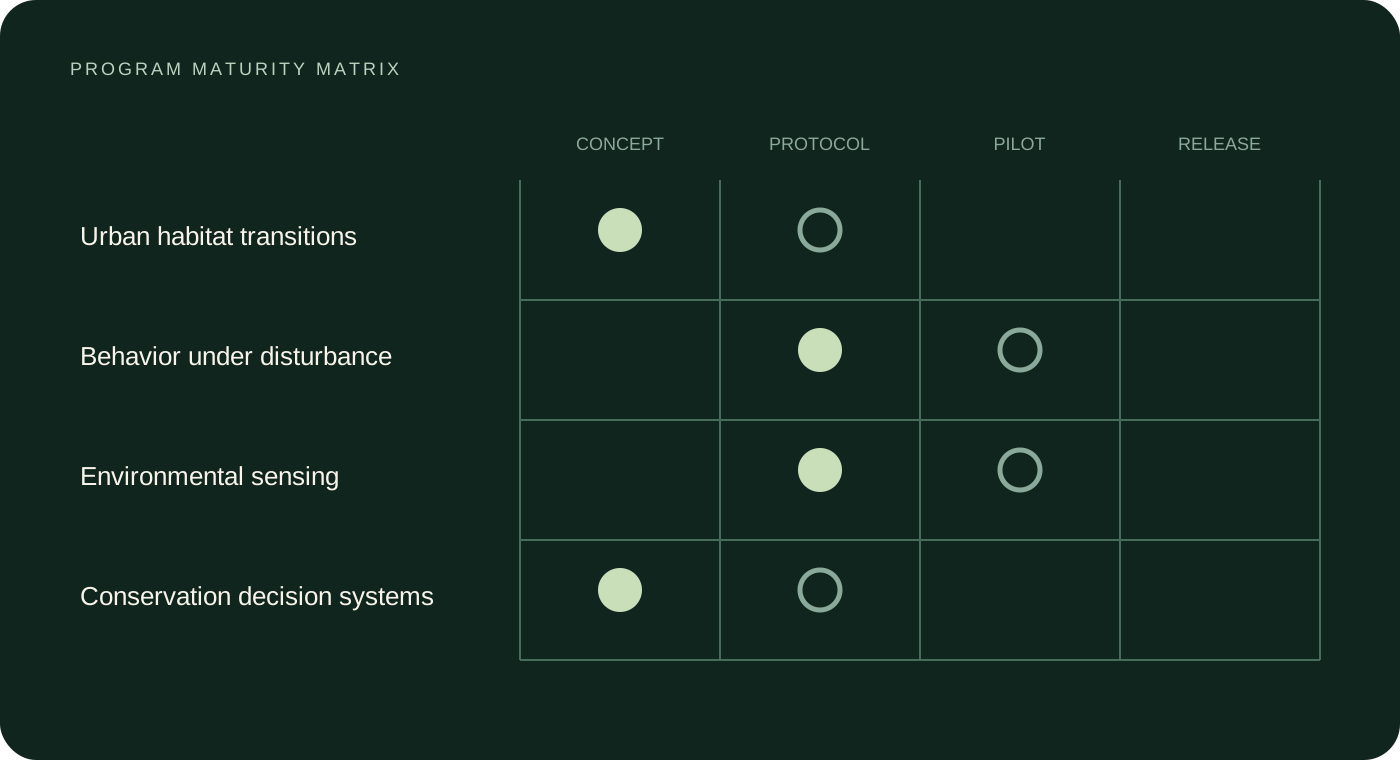
The center presents its active agenda, methods under development, pilot concepts, and planned outputs using explicit maturity labels.
Illustrative program governance matrix. A filled marker indicates the current primary stage. An outlined marker indicates the next review gate.
PROGRAM 01 · LANDSCAPE
Urban habitat transitions
Investigates how canopy, riparian, meadow, wetland, built edge, and transportation corridors alter ecological conditions over short distances.
Microhabitat classification
Edge and corridor geometry
Seasonal condition shifts
Fragment connectivity
PROGRAM 02 · BEHAVIOR
Response under disturbance
Develops non-invasive observation designs for how wildlife responds to people, sound, light, weather, maintenance activity, and habitat transitions.
Vigilance and displacement
Return and recovery timing
Movement-state annotation
Observer effect controls
PROGRAM 03 · SENSING
Environmental signal systems
Designs a unified data model for field notes, still imagery, acoustic records, weather, habitat context, and quality metadata.
Multimodal capture
Instrument provenance
Temporal synchronization
Quality flags and missingness
PROGRAM 04 · DECISION
Conservation decision models
Builds transparent scenario tools for deciding where repeated observation, habitat intervention, or additional evidence may have the highest value.
Monitoring prioritization
Uncertainty-aware scoring
Scenario comparison
Decision traceability
PORTFOLIO LOGIC
Each program feeds the next.
Habitat defines context. Behavior reveals response. Sensing determines what can be measured. Decision models define what additional evidence is worth collecting.
This structure prevents the website from presenting disconnected projects as a center. The programs share one data schema, one quality system, and one publication discipline.